Why these signs point at Humble's soil, not just "an old house"
Every home settles a little over decades. What separates ordinary aging from active foundation movement is a specific pattern of symptoms appearing together, and in Humble that pattern traces directly back to the soil and moisture systems covered on why Humble foundations move and the moisture cycle behind slab movement: differential clay movement racking one part of the house against another. The checklist covers what to watch for, how severe is "call someone" versus "keep an eye on it," and what an inspection measures once you do call.
The signs, one at a time
- Doors and windows that suddenly stick, rub, or won't latch. Look at the "reveal," the gap between the door and its frame. A gap that's narrower on one side than the other is a directional clue pointing toward where the foundation has settled.
- Sloping or uneven floors. The classic homeowner test: set a marble or a round object on the floor. If it consistently rolls one direction rather than sitting still, that's measurable slope worth investigating further, not just an old-house quirk.
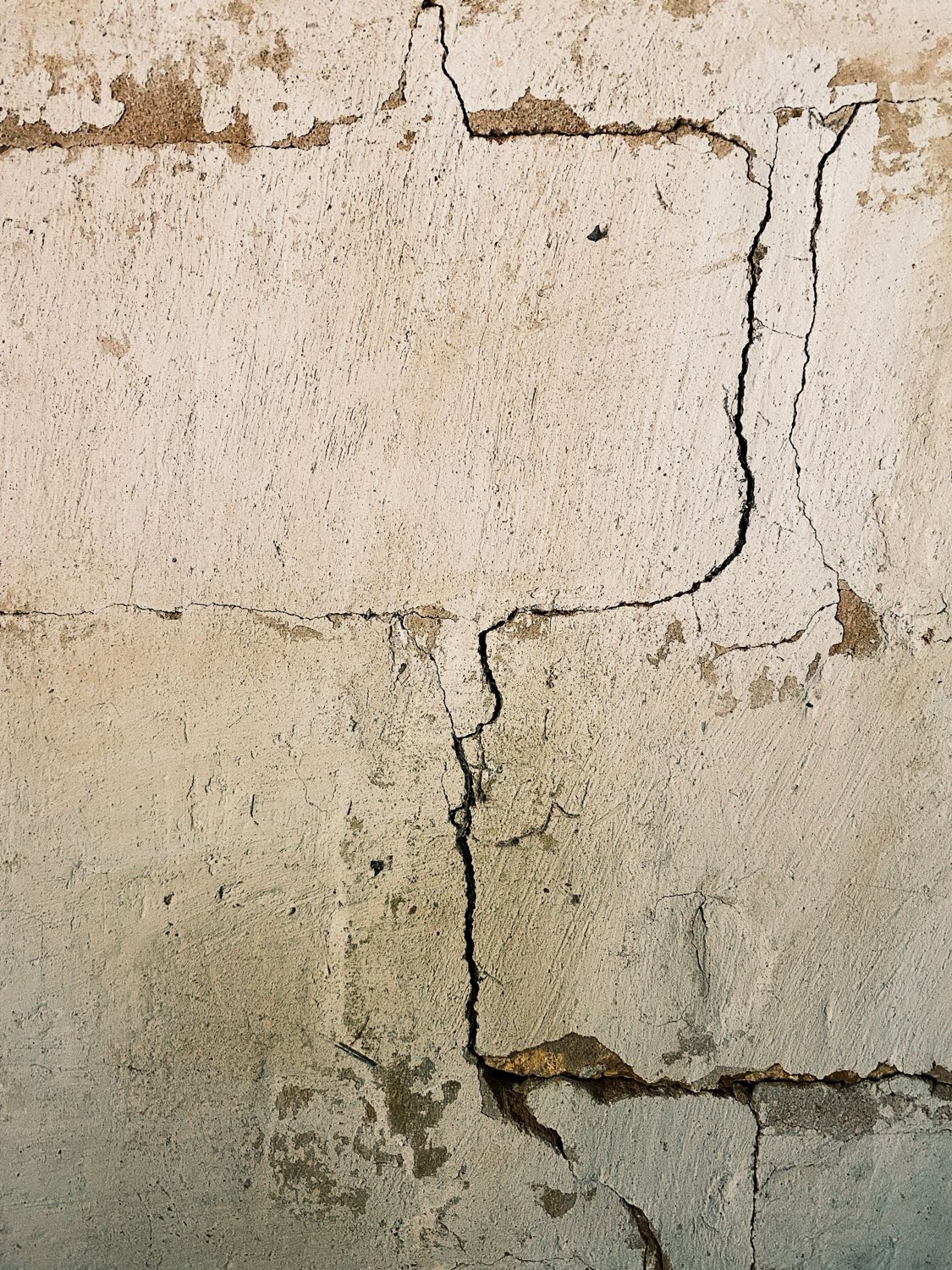
- Interior drywall cracks, especially diagonal or stair-step cracks running from the corners of doors and windows. Cracks that keep reopening after being patched are a stronger signal than a one-time hairline crack.
- Stair-step cracking in exterior brick, gaps opening up at trim, or separation where the brick meets the roofline. This is the classic visible signature of differential clay movement: the brick cracks in a diagonal, step-like pattern rather than a straight vertical line.
- Exterior gaps between the soil and the foundation, walkways that have started sloping away from level, or water visibly pooling against the slab after rain.
Severity: which cracks matter
Not every crack is a call-a-professional moment. A rough rule of thumb used across independent repair firms:
| Crack width | What it usually means |
|---|---|
| Hairline, under 1/16 in | Typically cosmetic (normal curing/settling) |
| 1/16 to 1/4 in | Worth monitoring; note if it's growing |
| Over 1/4 in, any horizontal crack, or any crack with visible displacement across the face | Signals a structural concern worth a professional look |
A diagonal or stair-step crack paired with sticking doors on the same side of the house is a stronger signal than either symptom alone. That combination is the pattern differential movement produces.
The pattern that ties back to Humble's climate
One diagnostic worth knowing specifically for this market: cracks that track the seasons, showing up or widening during the dry summer stretch and easing (though rarely disappearing entirely) after the wet season returns, point directly at the soil-moisture cycle described on the moisture cycle behind slab movement, rather than a one-time settlement event. That distinction matters because it changes the fix: a foundation moving with the seasons needs moisture management alongside any structural repair, not piers alone.
How a professional measures it
A homeowner's visual checklist gets you to "this is worth a call." An inspection turns that into an actual diagnosis:
- Floor-elevation (zone or manometer) survey. This maps relative floor heights across the entire house, turning "the floor feels off" into a measured slope pattern: which corner or wall has dropped, and by how much.
- A licensed structural engineer's report. This is the step that states the problem, identifies the likely cause, and specifies the recommended repair, including where piers should go and roughly how many. Typical cost runs about $300 to $800. It's a real expense, but it's also the only way to get an actual pier count and scope rather than a sales estimate.
- Post-tension slabs need a different first step. If the home has a post-tensioned slab, an inspector needs to locate the internal steel cables (using ground-penetrating radar or magnetic/ acoustic testing) before any coring or piering happens, because drilling through a live tensioned cable is a serious hazard.
What to do with the result
The engineer's report (or the inspecting contractor's read of the elevation survey) is what determines the repair scope: which methods make sense and roughly how many piers. That comparison is on repair methods and piers, and the honest cost ranges that follow from pier count are on foundation repair cost.
When it's fine to just monitor
If a crack is hairline, isn't growing, and isn't paired with sticking doors or sloped floors, it's usually fine to keep an eye on it rather than call immediately. Photograph it with a ruler for scale and a date, and re-check after the next dry-to-wet seasonal swing. If it hasn't changed, it's likely cosmetic.
Area covered
Humble, TX (ZIPs 77338, 77346, 77396), plus the Atascocita and Kingwood-adjacent area.